
Your Land Selling Guide
Expert tips for quick sales
Landly Land Buyers Blog
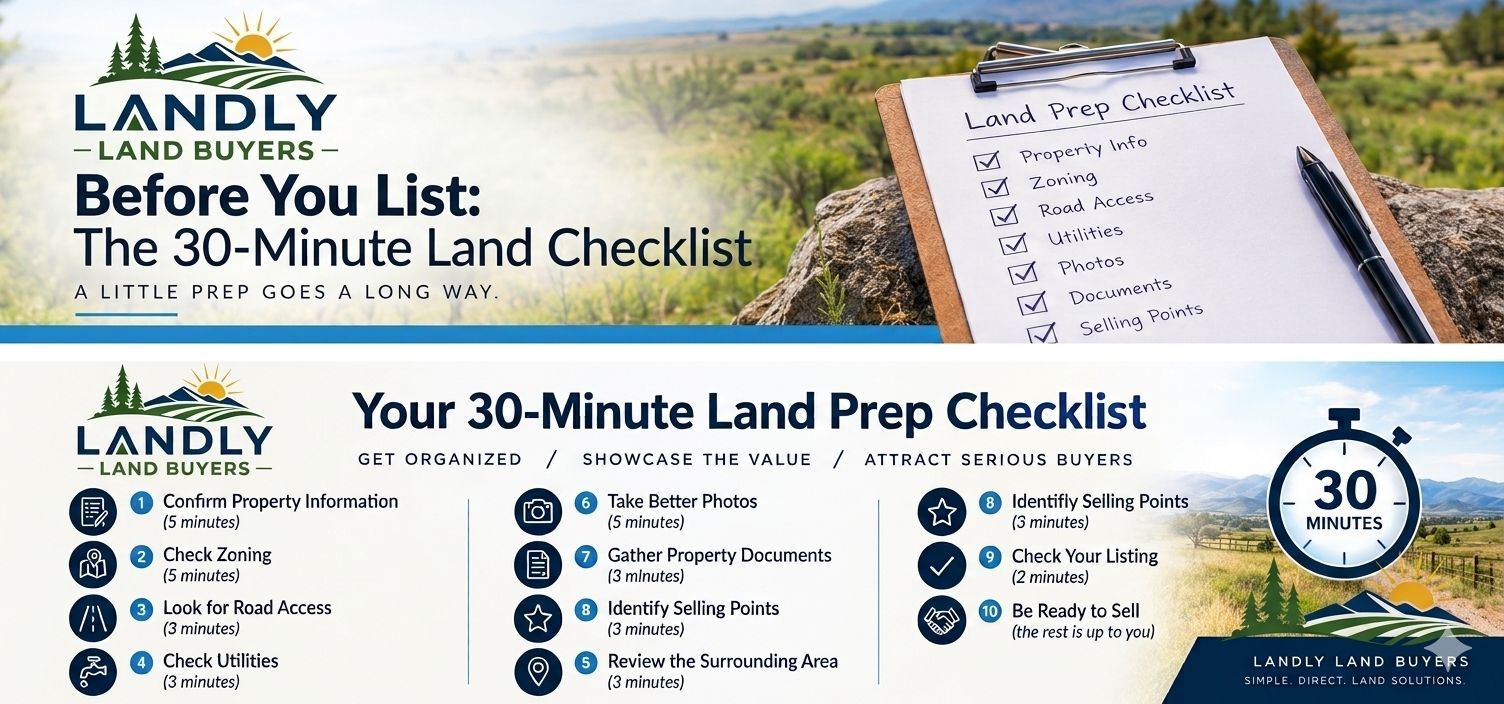
Before You List: The 30-Minute Land Prep Checklist
How to Sell Unwanted Land: A Hassle-Free Solution for Property Owners

Land Agents vs. House Agents: Why Your Listing Isn’t Getting Love

Inherited Land And Don’t Know What To Do? Start Here.

Owning vacant land can feel like a great investment—until you realize your property comes with major challenges. Maybe it has no road access. Maybe there’s no water, sewer, or electricity nearby. Or perhaps the zoning rules are so unusual that buyers don’t know what they can even do with it.

Cash offer letters can be a scam, a lowball, or a genuine opportunity—your outcome depends on how you evaluate the offer and what you need as a seller. Cash Offer Letters: Scam, Lowball, Or Opportunity? If you own a house or a piece of land, chances are you’ve seen them: glossy postcards, handwritten-style envelopes, or bold letters that say something like, “We’ll buy your property for cash—no repairs, no agents, close fast!” You might toss them straight into the trash, or you might pause and wonder if you’re leaving money on the table. So what are these cash offer letters, really? Are they scams, insulting lowball offers, or a legitimate shortcut to a simpler sale? Let’s break it down. What Cash Offer Letters Really Are (And Who Sends Them) Most cash offer letters are not from random individuals who just “fell in love” with your house or lot. They’re usually from people running an investment business. The sender is often one of these: House flippers looking for properties they can fix up and resell at a profit. Wholesalers who put your property under contract, then assign that contract to an end buyer (another investor) for a fee. Buy-and-hold investors who want rentals or long-term land positions but only at the right discount. In all of those models, the investor is not aiming to pay full retail. Their profit comes from buying below market, improving the property (or simply repositioning it), and then either renting or reselling. That doesn’t make them unethical by default. It just means their agenda is not the same as yours. Your goal is to maximize your net proceeds; their goal is to build in profit and cushion for risk. Scam vs Lowball: There’s a Difference Not every disappointing offer is a scam. Some are simply low. Others are genuinely predatory. Knowing the difference helps you react strategically instead of emotionally. Red Flags That Point Toward “Scam” Watch out for: Upfront fees Any “buyer” asking you to pay an application fee, processing fee, or “commitment deposit” directly to them is a major red flag. Legitimate investors make money when they buy and later resell, not by charging you for the privilege of talking to them. No proof of funds, no transparency If they can’t show a bank statement, a hard money approval, or verifiable funds, and won’t name the title company or closing attorney they use, proceed with extreme caution. Contracts packed with vague contingencies Extra-long inspection periods, the ability to cancel for almost any reason, or language that lets them market your property before closing can signal a wholesaler who may walk away if they can’t find another buyer. High-pressure tactics “Sign today or it’s off the table,” refusal to let you have your own agent or attorney review the contract, or constant pushing on your personal pain points (foreclosure, divorce, debt). When several of these show up together, it’s time to step back. In the worst cases, the goal is to tie up your property, waste your time, or squeeze you into a panic decision. When It’s Just a Lowball Offer A low number by itself is not a scam. It may simply be a reflection of the investor’s buying formula. Here’s roughly how many investors think: Start with what they believe the property will be worth after repairs (after-repair value, or ARV). Subtract the estimated cost of repairs and updates. Subtract their holding costs (taxes, insurance, utilities, loan interest, closing costs). Subtract their required profit margin. What’s left is often well below what a retail buyer might pay for a clean, move-in-ready home or buildable lot marketed on the MLS. From your perspective as the owner, that can feel insulting. From their perspective, it’s just math. You are not obligated to accept the discount—but it helps to understand why it’s there. Why Investors Can Offer Less (And Still Be Legit) Investors trade price for risk, time, and hassle. You trade some equity for speed and certainty. They often offer: As-is purchases No repairs, no credits, no contractors walking through your house or over your land for bids. Fast closings In some cases 7–14 days, depending on title work and local processes. No financing contingency True cash or hard money means no waiting on an underwriter or worrying about a buyer’s loan being denied. Fewer showings and less exposure For some sellers, especially in sensitive situations (probate, divorce, problem tenants), privacy is worth a lot. That package of benefits has a price. The question isn’t whether they “should” offer more; the question is whether the trade is worth it to you . When a Cash Offer Can Be a Real Opportunity There are situations where a discounted, legitimate cash offer is not just acceptable—it’s smart. Consider saying “Maybe” instead of “No way” if: You need speed more than top dollar Facing foreclosure, relocation, or major medical bills? A certain closing in a couple of weeks can be more valuable than squeezing out an extra 5–10% months from now. Your property has serious issues Foundation problems, major structural defects, heavy deferred maintenance, code violations, or unpermitted work can kill traditional deals. An investor expecting to fix problems anyway may be your most realistic buyer. You don’t have the budget to get it market-ready Painting, flooring, landscaping, roof work, staging, and cleaning add up quickly. If you can’t or don’t want to front that money, selling as-is at a discount might leave you ahead on a net basis. You prioritize convenience and privacy Not everyone wants signposts in the yard, open houses, and dozens of people walking through their home or driving by their land. In these cases, a good cash offer is less about “beating the market” and more about solving a problem efficiently. How To Quickly Evaluate Any Cash Offer Letter Here’s a simple framework you can use the next time a letter shows up. Step 1: Verify They’re Real Before you even talk price, confirm you’re dealing with a real buyer or legitimate wholesaler. Ask: “What’s your full name and company name?” “How many properties have you bought in this area?” “Do you close through a local title company or closing attorney? Which one?” “Are you the actual buyer, or will you be assigning this contract to someone else?” Then check: Look them up online (website, reviews, public records). Search your county’s property records to see if they or their LLC have actually closed on other properties locally. If they give you a title company name, confirm that company exists and is licensed in your state. If everything is vague or unverifiable, treat that as your answer. Step 2: Get a Baseline Value You can’t judge any offer without context. Talk to a local real estate agent or broker and ask for an “as-is” price opinion and a “fixed-up” estimate. If the property is unique or higher value, consider paying for an appraisal. Now you can compare the investor’s number to something more objective than your gut. Step 3: Compare Net, Not Just Price Suppose: A traditional sale might fetch 100 on the open market, but you’d spend 10 on repairs, 6 on commissions, and several months of taxes, insurance, and utilities. An investor offers 82 as-is and agrees to pay your standard seller closing costs. Run the math on what you’d actually walk away with in each scenario. Sometimes the “lower” cash price is closer than you think after repairs, holding costs, and fees. Step 4: Scrutinize the Terms Look beyond the headline number and study: How long is the inspection period? How long until closing? Are there vague contingencies that let them walk away easily? Are they asking for access to show contractors or “partners” before closing? Short, clear timelines and straightforward contingencies are your friend. Long, open-ended inspection windows are often used by wholesalers trying to find another buyer. Step 5: Decide Based on Your Priorities Ask yourself: Do I care more about top dollar or about certainty and speed? Can I comfortably afford repairs and months of carrying costs if I go the traditional route? Is the offer in front of me strong enough that, even if I could theoretically get more, I’d sleep better knowing it’s done? If the answer is yes, then that “cash investor” postcard might be an opportunity in disguise. If not, politely decline and move on. Smart Ways to Respond (Or Walk Away) If you’re at least curious, here’s how to engage without giving away your power. You can say something like: “Thanks for reaching out. I’m open to a cash sale if the numbers and terms make sense. Please email me a written offer, proof of funds, and the name of your title company so I can review everything.” Then: Get at least one other opinion (agent or another investor). Don’t sign anything you don’t understand—have an agent or attorney review the contract if possible. Be willing to counter. Their first number is usually not their last. And remember: your strongest negotiating tool is your ability to say “no.” Just because they sent a letter doesn’t mean you owe them a deal. Final Thought: Use the Letter, Don’t Let It Use You Cash offer letters are marketing. They’re designed to start a conversation with owners who value simplicity, speed, or relief from a problem property. Your job is to: Filter out the true scams. Recognize when an offer is simply low and not a good fit. Spot the rare but real situations where a discounted, clean, cash closing is the smartest move you can make. Handled correctly, that “We buy houses/land for cash” letter in your mailbox doesn’t have to be an insult. It can be a data point, a negotiating tool—or the fastest path to closing a chapter and moving on.

The five “silent deal‑killers” on vacant land are usually invisible at first glance but can quietly sabotage an otherwise great deal if you don’t dig for them. 1. Hidden Title Problems Vacant land is notorious for old liens, unreleased mortgages, probate tangles, or missing heirs that don’t show up until closing, when the title company refuses to insure. Any “cloud on title” can block financing, scare buyers, or drag a simple sale into months of legal cleanup. The danger is that sellers and new investors assume “no house = simple title,” when in reality rural and inherited parcels are often the messiest. To avoid this, always run a full title search early, review the report line‑by‑line, and clear defects before you market or close. If issues are too complex or expensive to fix, consider pricing the land as‑is and selling to a cash land buyer who specializes in curative work after purchase. 2. No Legal Access (Or Problematic Access) A parcel can be physically reachable by a dirt path yet have no recorded, legal access, making it “landlocked” in the eyes of lenders and cautious buyers. Without a deeded easement or road dedication, many banks will not finance, and title insurers may decline coverage, which kills conventional deals. Even when access exists, unclear easement language or disputes with neighbors can stall closings for months. Before you fall in love with a lot, verify access in writing: check the plat, recorded easements, and county road maps, and confirm the title company will insure over that access. If the property is landlocked, price in the cost, time, and risk of negotiating an easement or pursuing a legal solution—and know that many retail buyers will simply walk away. 3. Zoning, Use, and Buildability Traps Zoning, deed restrictions, conservation easements, or boundary issues can quietly make a parcel unusable for the buyer’s intended purpose. Buyers discover too late that the land is in the wrong zoning district, sits under strict covenants, or lies in an area where setbacks, wetlands, or conservation rules make building extremely difficult. These legal and regulatory surprises don’t just delay deals—they often cause them to collapse entirely when the numbers no longer work. The fix is proactive due diligence: pull current zoning from the local planning department, ask specifically what can be built, and get copies of any recorded restrictions or easements. For higher‑value deals, a fresh survey and a quick consult with a land‑use professional can confirm whether the parcel is truly buildable before you spend money on marketing or construction plans. 4. Invisible Soil, Environmental, and Flood Risks A vacant lot can look perfect but hide soil, drainage, flood, or contamination issues that explode construction costs or trigger liability concerns. Poor soils, high water tables, wetlands, or contamination can require expensive remediation, engineered foundations, or may even bar certain uses altogether. Once a buyer’s engineer or lender flags these problems, they often either renegotiate hard—or terminate the contract. On any serious purchase or high‑ticket sale, order basic environmental and soil evaluations instead of relying on guesswork. Checking FEMA flood maps, consulting local builders, and commissioning site‑specific tests where warranted will help you either price the land realistically or move on before you sink time and capital into a doomed deal. 5. Unrealistic Pricing and Expectations Even when the dirt itself is good, mispricing and seller expectations quietly kill more vacant land deals than most people realize. Land that is significantly overpriced relative to recent, verified comparables can sit on the market for years, especially if it lacks utilities, has access questions, or is in a weaker location. Sellers who price as if the lot were “build‑ready” when it’s not will scare away builders and retail buyers who actually run the numbers. Ground your price in real data: use only truly comparable lots (similar size, utilities, location, and zoning), adjust for any deficiencies, and watch what local builders and active land buyers are actually paying—not just what other sellers are asking. When you align price with reality and pair it with transparent disclosures about title, access, and usability, you turn silent deal‑killers into known, manageable risks—and that’s when vacant land actually starts to move.

The Real Reasons Your Land Is Still Sitting

How to sell your land fast