Before You List: The 30-Minute Land Prep Checklist
Before You List: The 30-Minute Land Prep Checklist
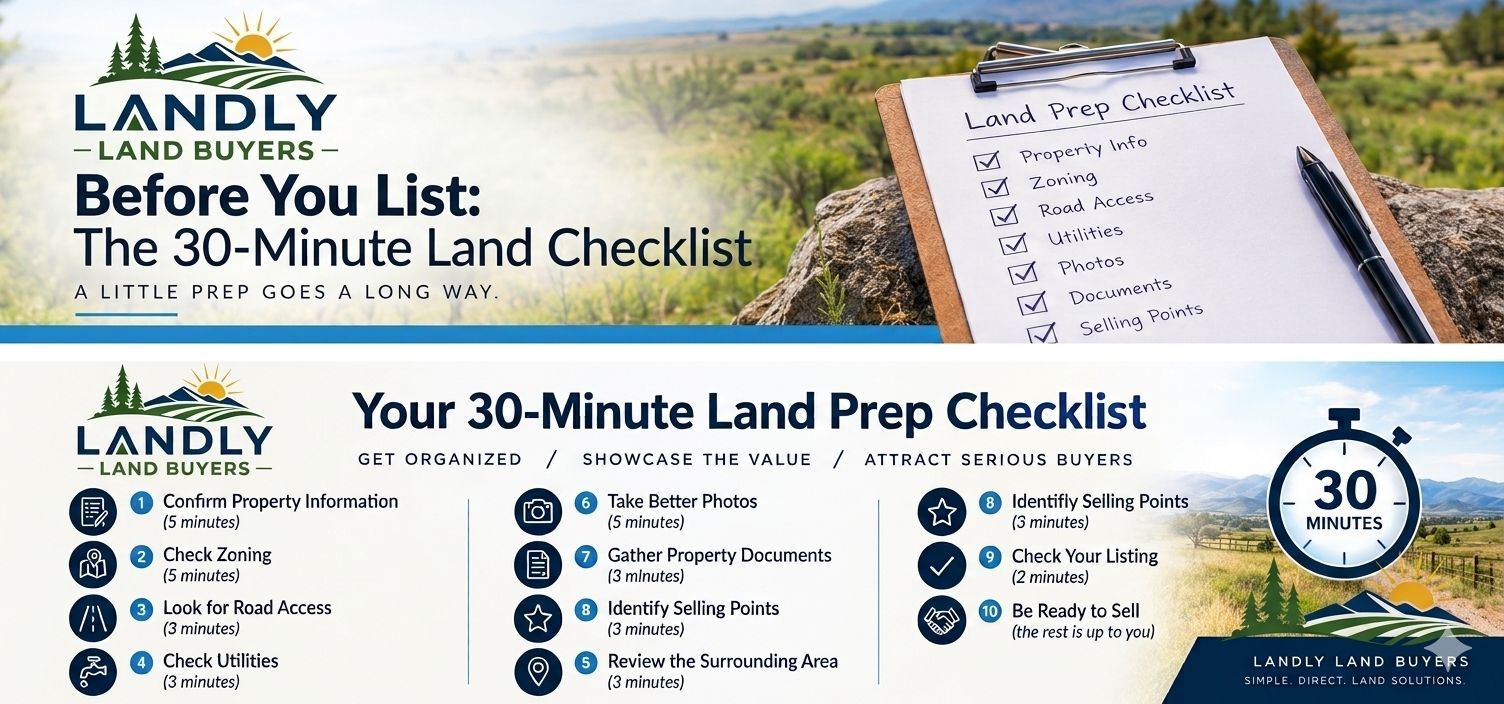
Selling vacant land can seem simple: take a few pictures, put up a listing, and wait for an offer. But a little preparation before you list can make a big difference in how buyers perceive your property.
The good news? You don't need to spend weeks getting your land ready.
With this 30-minute land prep checklist, you can gather the basic information buyers want, identify potential issues, and create a stronger listing before putting your property on the market.
If you're considering selling quickly without dealing with the traditional listing process, you can also explore your options with Landly Land Buyers.
1. Confirm Your Property Address and Parcel Number — 5 Minutes
Start with the basics.
Locate your most recent property tax bill, deed, county assessment, or other property records and confirm:
- Property address or nearest street address
- Parcel number/APN
- County and state
- Lot size
- Legal description, if available
- Current owner name
Having accurate property information helps prevent confusion when creating your listing and makes it easier for prospective buyers to research the property.
If you don't have all of this information readily available, don't panic. Your county assessor or property records office may have additional information.
2. Check the Zoning — 5 Minutes
Zoning can significantly affect what someone can do with vacant land.
Spend a few minutes finding out the property's current zoning classification and, if possible, determine what uses are permitted.
Depending on the location, buyers may want to know whether the property can potentially be used for:
- A single-family home
- Multiple residential units
- Manufactured housing
- Agricultural purposes
- Commercial development
- Recreational use
- Other permitted activities
Don't assume that a parcel is buildable simply because nearby properties have homes.
If you're unsure about zoning or development restrictions, make a note in your listing rather than making an unsupported claim.
3. Look for Road Access — 3 Minutes
One of the first questions a land buyer may ask is:
"How do I get to the property?"
Check whether your property appears to have access from a public road.
Look at a map or satellite image and identify:
- Paved road access
- Dirt or gravel road access
- Private roads
- Driveway access
- Potential access issues
If the property appears landlocked, investigate whether an easement or other legal access exists before advertising the property as easily accessible.
Access can have a major impact on a vacant lot's desirability and potential use.
4. Check Utilities — 3 Minutes
Utilities are another major consideration for land buyers.
Take a quick look at what appears to be available near the property:
- Electricity
- Water
- Sewer
- Natural gas
- Internet
- Septic potential
Don't assume utilities are available simply because utility lines appear nearby.
Instead, identify what you know and what still needs to be verified.
For example, your listing could say:
"Electricity appears to be available along the road; buyer to verify connection requirements and costs."
That is much safer than promising that utilities are already connected.
5. Review the Surrounding Area — 3 Minutes
Take a few minutes to look beyond the property boundaries.
Open a map and check the surrounding neighborhood.
Look for:
- Nearby homes
- New construction
- Major roads
- Schools
- Shopping
- Parks
- Businesses
- Industrial areas
- Bodies of water
- Vacant parcels
Understanding the surrounding area can help you describe the property's location more effectively.
Instead of simply saying "1-acre vacant lot," you might be able to explain that the property is located near established homes, a major highway, or local amenities.
6. Take Better Property Photos — 5 Minutes
You don't need professional photography to create a useful land listing.
Take several clear pictures showing:
- The property from the road
- The entrance or access point
- The surrounding road
- Different views of the parcel
- Nearby homes or development
- Any notable features
If you can safely access the property, take photos from multiple angles.
Avoid misleading photos. If a picture shows a neighboring home, make it clear that the home is not included with the property.
Clear, honest photos can help buyers understand what they're actually considering.
7. Gather Your Basic Property Documents — 3 Minutes
Before publishing your listing, create a simple folder containing whatever documents you already have.
Consider including:
- Property tax records
- Deed
- Survey
- Plat map
- Previous appraisal
- Zoning information
- HOA information
- Utility information
- Environmental reports
- Other relevant property documents
You don't necessarily need every document before listing. The goal is simply to know what information you already have and what may still need to be researched.
8. Write Down the Property's Biggest Selling Points
Now that you've spent 30 minutes researching and preparing the property, write down three to five legitimate selling points.
For example:
- 0.75-acre residential lot
- Located near established homes
- Paved road frontage
- No HOA
- Close to a growing community
- Mountain views
- Near recreational areas
Keep your claims factual.
Avoid phrases such as "guaranteed buildable," "unlimited possibilities," or "best lot in the county" unless you have solid documentation supporting those statements.
What If You Don't Want to Deal With Listing the Property?
Preparing and listing vacant land isn't difficult, but it can still involve research, phone calls, negotiations, showings, buyer questions, and waiting for the right buyer.
For property owners who prefer a more direct approach, Landly Land Buyers provides another option to consider when selling unwanted land.
A direct land sale may eliminate some of the steps involved with a traditional listing, depending on the property and the buyer.
Your 30-Minute Land Prep Checklist
Before you hit "publish," make sure you've completed these quick steps:
☐ Confirm the parcel number and property information
☐ Verify the lot size
☐ Check the zoning
☐ Determine apparent road access
☐ Research nearby utilities
☐ Review the surrounding area
☐ Take clear property photos
☐ Gather available documents
☐ Identify three to five legitimate selling points
☐ Double-check your listing for inaccurate claims
That's it.
You don't need to have every question answered before you begin. But spending 30 minutes gathering the basics can make your listing more informative and help you respond confidently when potential buyers start asking questions.
Ready to Sell Your Land?
If your property has become more of a burden than an asset, you don't necessarily have to wait for a traditional buyer to come along.
You can research your options, compare potential offers, and decide which selling method makes the most sense for your situation.
If you'd like to explore a direct sale, visit Landly Land Buyers to learn more about selling unwanted land.
A little preparation can go a long way—but you don't have to make selling your land complicated.